
How to Generate Leads on LinkedIn: 7 Strategies Every Entrepreneur Should Know
You don’t need thousands of followers to find your next client on LinkedIn. You need the right people to notice you, understand your value, and feel confident enough to start a conversation.
For entrepreneurs and small business owners, that distinction matters. You might have an excellent service, years of experience, and a solution your ideal customers genuinely need. However, if your LinkedIn presence doesn’t communicate that value, or you’re connecting with people without a clear plan, turning visibility into business opportunities can be challenging.
The good news? LinkedIn offers more than a place to showcase your professional experience. Used strategically, it can help you identify potential clients, build credibility, nurture relationships, and generate qualified leads without relying entirely on cold calls or paid advertising.
At designACE, we believe effective LinkedIn lead generation starts with understanding people, communicating value, and building genuine relationships. Here are seven practical strategies entrepreneurs, CEOs, and business leaders can use to turn LinkedIn activity into meaningful business opportunities.
1. Start With a Clear LinkedIn Lead Generation Strategy
Start With a Clear LinkedIn Goal
Before sending connection requests or publishing content, define what a successful lead looks like for your business.
Without a clear direction, it’s easy to spend hours growing your LinkedIn network without attracting people who need your services. A larger network can increase your reach, but relevant connections are far more valuable than numbers alone.
Define your ideal customer
Start by identifying the people most likely to benefit from what you offer. Consider their:
Industry: Which sectors need your expertise?
Job title: Are you targeting founders, CEOs, marketing directors, or business development managers?
Business size: Do you work with startups, small businesses, or established organizations?
Challenges: What problems are they trying to solve?
Buying readiness: Are they actively looking for a solution, exploring options, or simply learning about their challenges?
For example, a LinkedIn consultant might target founders of growing B2B companies who want to improve executive visibility but lack the time or resources to manage their LinkedIn presence consistently.
That level of specificity makes it easier to create relevant content, identify prospects, and personalise outreach.
Set measurable goals
Your LinkedIn strategies should support clear business objectives. Rather than aiming to gain 500 connections in a month, consider setting goals such as generating 10 qualified conversations, booking four discovery calls, or securing two new clients within a defined period.
These are illustrative targets, not guaranteed results. Your benchmarks should reflect your capacity, industry, and sales cycle.
For additional guidance, explore how small business owners can use their personal LinkedIn profiles.
2. Optimize Your LinkedIn Profile to Attract Potential Clients

Optimise Your LinkedIn Headline to Earn More Profile Clicks
Think of your LinkedIn Profile as your digital introduction. When a potential client discovers you through a post, comment, or connection request, they will often visit your profile before deciding whether to engage.
If your profile focuses entirely on your job title, responsibilities, and achievements, you might miss an opportunity to explain how you help people.
Effective LinkedIn Optimization makes your expertise easier to understand and gives visitors a reason to take the next step.
Make your value immediately clear
Start with these essential elements:
Your headline: Go beyond your title. Explain who you help and what outcome you support.
For example, instead of “Founder at ABC Consulting,” consider “Helping Small Businesses Improve Marketing Strategy and Generate Qualified Leads.”
Your banner: Use this visual space to reinforce your positioning. Include your core service, a concise value proposition, and a relevant call to action where appropriate.
Your About section: Write in a conversational first-person voice. Explain the challenges you solve, your approach, and the people you work with. Include a clear next step, such as visiting your website or booking a discovery call.
Your Featured section: Showcase useful resources, case studies, client success stories, service pages, or relevant articles that demonstrate your expertise.
Your experience and recommendations: Highlight outcomes and meaningful contributions rather than simply listing responsibilities. Where possible, support your claims with specific examples and authentic client testimonials.
Treat your profile as a landing page
A well-optimized profile should answer three questions: Who do you help? How do you help them? Why should they trust you?
For a more comprehensive refresh, explore LinkedInMakeover.ca, which helps professionals strengthen their positioning and create a more compelling LinkedIn presence.
3. Create LinkedIn Content That Addresses Real Customer Problems

Create LinkedIn Content That Addresses Real Customer Problems
Your content should do more than keep your profile active. It should help potential clients recognise their challenges, understand possible solutions, and see your business as a credible resource.
The most effective LinkedIn Content often begins with questions your audience already asks, frustrations they experience, or decisions they struggle to make.
Build content around customer needs
A practical content strategy can include four categories:
Educational content: Share actionable tips, explain common mistakes, or simplify complex topics.
Thought leadership: Offer informed perspectives on industry trends, emerging challenges, and business decisions.
Experience-based content: Share lessons learned, behind-the-scenes insights, and stories that demonstrate how you approach problems.
Proof-driven content: Present case studies, client feedback, project outcomes, and examples of your work, with permission where appropriate.
For example, a business consultant could publish a carousel titled “5 Signs Your Marketing Strategy Is Generating Activity but Not Leads.” The post could explain each warning sign and offer practical ways to address it.
This approach attracts people who recognise the problem and may eventually need professional support.
Use formats that encourage meaningful engagement
Experiment with text posts, document carousels, short videos, polls, and case studies. Each format serves a different purpose, so evaluate performance based on your audience and objectives rather than assuming one format always wins.
Most importantly, create a strong opening. Instead of starting with “I’m excited to share some marketing tips,” try “Your business might not need more leads. It might need a better way to qualify them.”
The second opening gives readers a specific reason to continue.
Consistency also matters, but it doesn't mean publishing every day. Choose a sustainable schedule that allows you to share useful ideas and participate in conversations.
For more practical advice, read ACE-ing LinkedIn Content: Strategies for Connection and Growth.
4. Build Relationships Through Meaningful LinkedIn Engagement

Build Relationships Through Meaningful LinkedIn Engagement
Publishing valuable content is only one part of lead generation. You also need to participate in conversations and build familiarity with the people you want to reach.
LinkedIn Engagement helps you become more visible within relevant professional communities while demonstrating how you think and communicate.
Engage before you pitch
Identify potential clients, industry leaders, complementary service providers, and referral partners. Follow their updates and contribute thoughtfully when they discuss topics related to your expertise.
For instance, if a business owner posts about struggling to attract qualified customers, you could share a practical suggestion or ask a thoughtful follow-up question.
Avoid responding to every post with generic comments such as “Great insights!” Instead, add a perspective, share a relevant experience, or ask something that advances the conversation.
You can also engage with company updates, industry discussions, and posts from existing connections. These interactions help establish familiarity before you initiate a direct conversation.
Make your outreach personal
When sending a connection request, explain why you want to connect. Mention a shared interest, a relevant post, a mutual professional connection, or something specific about their work.
For example:
“Hi Sarah, I enjoyed your recent post about growing a small business without expanding the marketing team. I work with businesses on LinkedIn strategy and would love to connect and exchange ideas.”
Once connected, resist the urge to immediately deliver a sales pitch. Start a genuine conversation, learn more about their priorities, and look for opportunities to offer something useful.
If there is a natural fit, introduce your service when it becomes relevant.
Our guide to LinkedIn outreach explores how to build connections through thoughtful, personalised communication.
5. Turn Conversations Into Qualified Leads With a Clear Next Step

Turn Conversations Into Qualified Leads With a Clear Next Step
A connection is not automatically a lead, and a lead is not automatically a customer. To generate business opportunities consistently, you need a process that helps interested prospects move from conversation to action.
Offer a useful next step
Not every prospect is ready for a sales call. Some may need more information before they feel comfortable discussing their business challenges.
Consider offering different next steps based on their level of interest:
Early-stage prospects: Share a relevant article, checklist, or educational resource.
Interested prospects: Offer a short consultation, personalised assessment, or demonstration.
Sales-ready prospects: Invite them to a discovery call to discuss their needs, objectives, and potential solutions.
Your call to action should be clear and relevant to the conversation. For example, if someone asks how to improve their executive visibility, you might offer to review their current LinkedIn positioning and suggest a few areas for improvement.
You can also direct interested prospects to a service page that explains your process, deliverables, and next steps.
Follow up without being pushy
A thoughtful follow-up can keep a useful conversation moving. However, repeated messages without new context or value can damage trust.
Reference your previous discussion, share something relevant, or ask whether the information you provided was helpful.
For example:
“Hi Sarah, I wanted to follow up on our conversation about your LinkedIn content strategy. I came across a resource that might help with the challenge you mentioned. Would you like me to send it over?”
Give people room to respond, and respect their decision if they are not interested.
For a deeper look at this process, read The Follow-Up Formula: Outreach Without Being Pushy.
6. Combine Personal Branding, Company Visibility, and Consistent Follow-Through

For entrepreneurs and executives, lead generation becomes more effective when your personal brand and company presence reinforce one another.
Your personal profile allows people to connect with the person behind the business. Your company page provides another place to learn about your services, expertise, team, and work.
Give each presence a purpose
Use your personal profile to share perspectives, professional experiences, and conversations that reflect your expertise. Meanwhile, use your company page to highlight services, company updates, client outcomes, and organisational insights.
When the two work together, prospects can discover your ideas, learn about your business, and find a logical next step.
A coordinated LinkedIn campaign can support this process through targeted content, relevant audience research, relationship-building activities, and clear calls to action.
For businesses with limited internal resources, LinkedIn management services can help maintain consistency across content planning, publishing, engagement, and outreach. The goal is to make your LinkedIn presence more strategic without adding an unmanageable workload.
Track what contributes to business growth
Review your results regularly. Useful indicators include:
Profile views from relevant prospects.
Connection acceptance and meaningful reply rates.
Conversations with potential customers.
Qualified discovery calls booked.
Leads that progress through your sales process.
Opportunities and revenue attributable to LinkedIn.
Impressions and reactions can reveal whether your content attracts attention, but they do not necessarily indicate purchase intent.
Use analytics to identify patterns. Which topics attract your ideal audience? Which conversations lead to discovery calls? Which outreach messages receive thoughtful responses? Where do interested prospects stop progressing?
Use those insights to refine your approach rather than repeating activities simply because they generate visible engagement.
7. Tap Into LinkedIn Groups and Industry Communities

Tap Into LinkedIn Groups and Industry Communities
Your next potential client might already be participating in conversations about the challenges your business solves. LinkedIn Groups and relevant industry communities can help entrepreneurs discover these conversations, connect with like-minded professionals, and build relationships beyond their existing network.
Instead of waiting for prospects to discover your profile, you can become part of the discussions where your expertise is relevant.
Find communities where your ideal clients participate
Look for LinkedIn Groups and professional communities related to your target industries, business challenges, or areas of expertise. Prioritise active communities where members exchange practical advice, discuss industry developments, and ask questions that align with your services.
For example, a marketing consultant targeting small business owners could participate in communities focused on entrepreneurship, business growth, or digital marketing.
Contribute value before promoting your services
Once you join a relevant community, observe its discussions and participation guidelines. Answer questions, share useful insights, and offer practical suggestions based on your experience.
If a member asks how to improve their company's LinkedIn presence, you could explain a few common optimization mistakes and suggest ways to address them. When appropriate, share a relevant resource that expands on your advice.
Avoid treating every discussion as a sales opportunity. Consistent, helpful participation demonstrates your expertise and gives people a reason to remember you when they need professional support.
Turn relevant discussions into genuine connections
When someone shares a challenge that aligns with your services, look for a natural opportunity to continue the conversation. You might respond to their discussion, ask a thoughtful question, or connect with them directly when there is a clear reason to do so.
Over time, these interactions can help you build relationships with potential clients, referral partners, and industry peers.
Quick Tips: Your LinkedIn Lead Generation Checklist
Define your ideal customer and the problem you solve.
Optimize your headline, About section, banner, and Featured section.
Publish useful content that addresses real customer challenges.
Engage thoughtfully with relevant people and industry discussions.
Personalise connection requests and follow-ups.
Offer a clear next step when interest emerges.
Review lead quality and conversion results every month.
Turn Your LinkedIn Presence Into Meaningful Business Opportunities
Effective LinkedIn lead generation isn't about collecting connections or chasing engagement for its own sake. It's about helping the right people discover your expertise, building trust through useful conversations, and making it easy for potential clients to take the next step.
Start with a clear strategy, strengthen your LinkedIn Profile, create relevant content, and engage with your network intentionally. Then measure what matters: qualified conversations, promising opportunities, and business outcomes.
If you want expert guidance, designACE offers a free personalised LinkedIn profile audit conducted by Andrew Charles Edwards, CEO and co-founder. You'll receive a scorecard and a LinkedIn banner template to help you identify opportunities to improve your presence.
Book your free LinkedIn audit and discover how to make your LinkedIn presence work harder for your business.
You can also explore our LinkedIn management services, LinkedIn training, and LinkedIn campaign services to find the right support for your goals.
Frequently Asked Questions (FAQs)
-
No. You can identify prospects, research profiles, publish content, and build relationships using LinkedIn's standard features. Sales Navigator is a paid option that may be useful when you need more advanced prospecting filters, lead lists, and account research. Consider it when your current process or prospecting volume justifies the investment.
-
Yes. Local consultants, service providers, agencies, and B2B businesses can use LinkedIn to connect with decision-makers in their region. Focus on relevant industries, local business communities, referral partners, and conversations about challenges your services address. LinkedIn can complement local networking and other marketing channels.
-
The easiest way to receive recommendations is to ask people you've genuinely worked with, such as colleagues, clients, managers, or business partners. Make the request as easy as possible by reminding them of projects you worked on together or suggesting a few areas they could mention. Offering to write a recommendation for someone else first is also a thoughtful way to start the conversation and often encourages them to return the favour.
-
Use a simple customer relationship management (CRM) system or spreadsheet to record prospects, their needs, previous conversations, follow-up dates, and next actions. Keep notes relevant and handle contact information responsibly. A consistent tracking process makes it easier to maintain relationships and avoid losing promising opportunities.
-
Look for signals such as questions about pricing, implementation, availability, specific deliverables, or how your service addresses their current challenge. These signals suggest interest, but they do not guarantee buying intent. Ask relevant questions, understand their priorities, and agree on an appropriate next step rather than making assumptions.
Useful Blogs


LEVEL UP YOUR LINKEDIN PROFILE
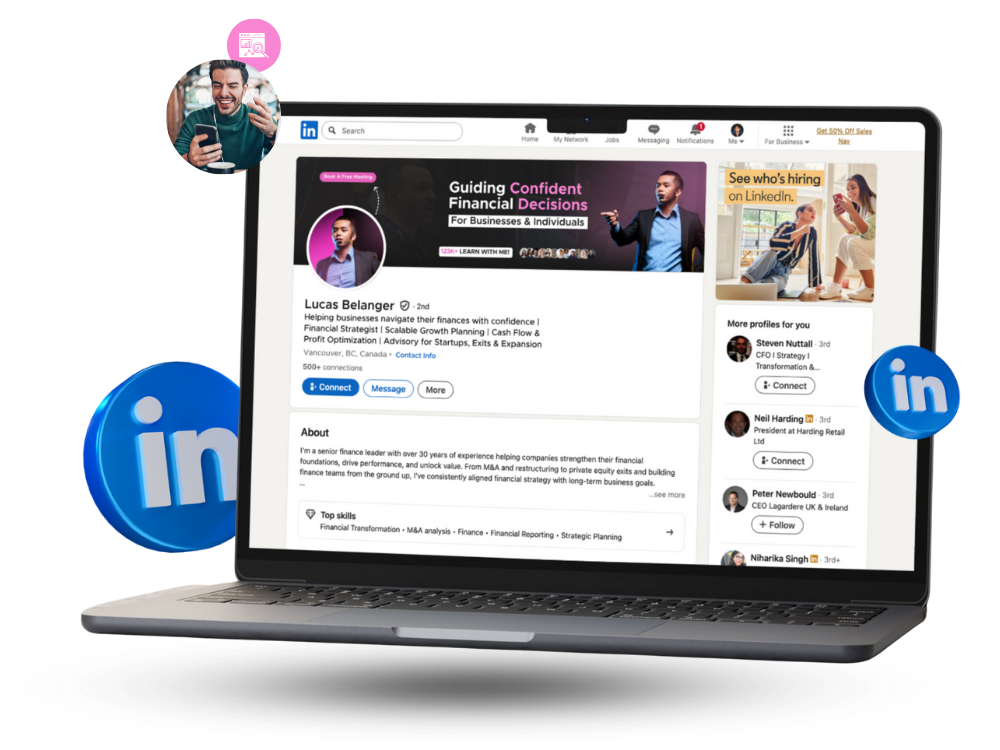
Enhance your LinkedIn presence and attract more opportunities with a profile designed to stand out.
PICK YOUR MAKEOVER
Discover 7 practical LinkedIn lead generation strategies for entrepreneurs, small businesses, CEOs, and executives. Learn how to attract qualified leads, build trust, and turn LinkedIn connections into business opportunities.