
How to Create LinkedIn Content That Builds Trust, Engagement, and Real Business Growth
One of the biggest mistakes I see people make on LinkedIn is jumping straight into posting without a clear strategy.
They know they should be active. They know LinkedIn can help them build credibility, grow their network, and generate opportunities. So they start posting. Maybe they share an article, upload a photo from an event, or write a quick update about their business.
Then they wait, and wait. Only to find that their content gets very little engagement. What often surprises people is that success on LinkedIn isn't necessarily about posting more often. It's about posting with purpose.
What You’ll Learn to Improve Strategies for Connection and Growth
In this blog, we'll explore how to create LinkedIn content more intentionally:
Why content plays such an important role in professional visibility
How to craft posts that encourage meaningful engagement.
Writing stronger hooks
Choosing the right content formats
Using authenticity as a strategic advantage
Understanding when to post
Turning content into conversation
Because great LinkedIn content isn't about being the loudest voice in the room. It's about being the most relevant.
Why Do You Need to Strategize LinkedIn Content?

Why Do You Need to Strategise LinkedIn Content?
Unlike platforms where content is often consumed daily and in large volumes, LinkedIn users tend to be more selective about what they engage with. The platform prioritises relevance, value, and meaningful interactions over simply showing the newest content available. In other words, visibility comes from creating content that resonates with your audience, and not from posting for the sake of posting.
That's why, before creating any content, I always encourage people to start with a goal.
Start With a Goal Before You Create Content
One of the first questions I ask people when they tell me they want to be more active on LinkedIn is: "What are you hoping to achieve?"
Surprisingly, many people haven't thought that far ahead.
They know they should be posting. They've heard LinkedIn is important for personal branding, networking, and business development. They see competitors and colleagues sharing content regularly. So they jump in and start posting without a clear objective. The problem is that content without a goal often feels exactly that, no direction at all.
Before creating your next LinkedIn post, take a step back and ask yourself:
Do I want to showcase my expertise?
Am I trying to build professional credibility?
Do I want to nurture relationships with existing connections?
Am I hoping to generate leads or business opportunities?
Do I want to expand my network and reach new audiences?
There's no right or wrong answer. In fact, many professionals use LinkedIn for several of these reasons. The important thing is understanding which goal is driving your content strategy at any given time.
The Problem With Posting Without a Goal
When there's no strategy behind your content, a few things tend to happen.
First, your content becomes inconsistent. One day you're sharing an industry article. The next day you're posting a motivational quote. Then you disappear for three weeks before promoting a service. To your audience, it becomes difficult to understand who you are, what you do, and why they should follow you.
Second, your messaging becomes diluted. If every post serves a different purpose, your audience receives mixed signals. Instead of building authority around a specific topic or area of expertise, you end up talking about everything and becoming known for very little.
Third, engagement often suffers. LinkedIn's algorithm pays attention to how people interact with your content. If your posts don't resonate with a specific audience or support a consistent theme, it's harder to build momentum and meaningful engagement over time.
Finally, there's no way to measure success. If you haven't defined your goal, how do you know whether your content is working? A post that generates ten new conversations may be far more valuable than one that receives hundreds of likes. A post that leads to a new partnership may outperform one that reaches thousands of people. Success on LinkedIn isn't always about visibility, but it's about achieving the outcome you set out to accomplish.
When you know what you're trying to achieve, every post becomes more intentional, more relevant, and ultimately more effective.
Why LinkedIn Content Works Differently Than Other Social Platforms?
What should I do before optimising my LinkedIn profile?
You've probably heard the phrase "content is king." While that's still true on LinkedIn, there's another factor that often gets overlooked: Context matters just as much as content.
The reality is that LinkedIn isn't designed to be used the same way as other social platforms. People typically visit Instagram to be entertained, Facebook to stay connected, and X to follow conversations in real time. LinkedIn, on the other hand, is a professional platform where people go to learn, network, solve problems, explore opportunities, and stay informed about their industries. People assume that if something performs well on one platform, it should perform well everywhere, but LinkedIn behaves differently.
That difference changes how content is consumed.
Content Is Still King, But Context Matters
Unlike Instagram or TikTok, where users may scroll through dozens or even hundreds of posts in a single session, LinkedIn users tend to be more selective with their time and attention.
Many professionals aren't checking LinkedIn multiple times a day. They might browse during a lunch break, while commuting, before a meeting, or at the end of their workday. When they do log in, LinkedIn's job is to show them content that feels relevant and valuable.
That's why the platform doesn't simply prioritize the newest content available. Instead, LinkedIn looks for signals that suggest a post is worth showing to more people.
If your content receives meaningful engagement early: such as reactions, comments, shares, or dwell time; the platform is more likely to continue distributing it. If people scroll past it without interacting, LinkedIn may limit its reach and prioritize other content instead.
In other words, strong-performing content gets amplified; and weak-performing content gets buried. This is one of the reasons content quality matters so much on LinkedIn. Publishing frequently can help, but frequency alone won't overcome content that fails to connect with the audience you're trying to reach.
Why Some Businesses Thrive on Other Platforms but Struggle on LinkedIn
LinkedIn users generally have different expectations when they open the platform. They are often looking for insights, professional experiences, lessons learned, industry trends, and conversations that help them grow personally or professionally.
That doesn't mean every post needs to be serious or educational. Authentic stories, personal experiences, and behind-the-scenes moments can perform exceptionally well. The difference is that successful LinkedIn content typically provides some form of value alongside the story. This includes:
A lesson learned.
A challenge overcome.
A unique perspective.
A practical takeaway.
The most effective content isn't just interesting, but it helps the audience think differently, learn something new, or feel connected to the person sharing it.
Understanding the LinkedIn Mindset
Before creating content, it's worth considering the mindset of the people you're trying to reach. Ask yourself:
What challenges are they facing right now?
What insights would be useful to them?
What experiences can I share that they may relate to?
What conversation am I trying to start?
The more relevant your content feels to your audience, the more likely it is to generate engagement, build credibility, and support your goals on the platform. That's why successful LinkedIn content isn't about posting more often than everyone else.
It's about creating content that feels relevant enough for someone to stop scrolling, pay attention, and join the conversation.
Why Does Your Hook Matters on LinkedIn?
Why Does Your Hook Matters on LinkedIn?
Before someone reads your post, engages with your content, or learns from your insights, they have to make a simple decision: Is this worth my attention?
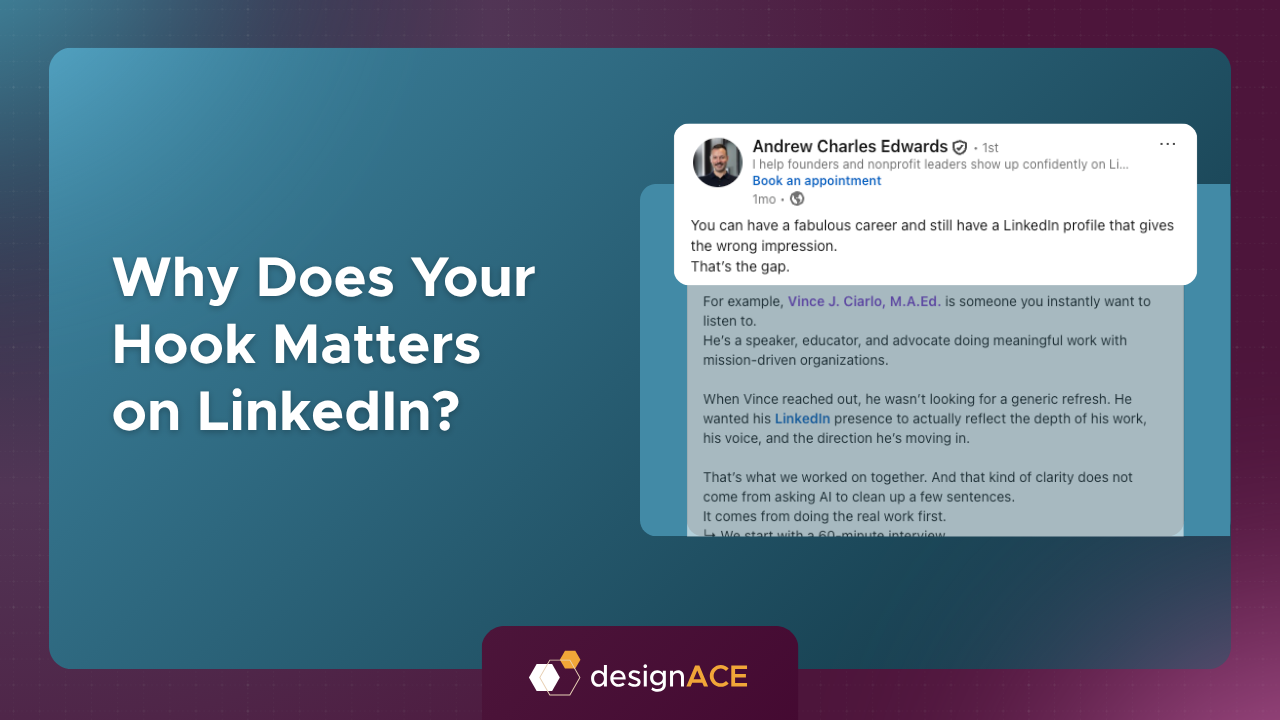
On LinkedIn, only a small portion of your post is visible before it gets cut off behind the "See More" button. In most cases, readers will only see the first one or two lines before deciding whether to continue. A research from Microsoft shows that the average human attention is only 8 seconds, which is shorter than that of a goldfish. So, you need to have a strong hook that will grab audience attention in under 8 seconds.
Hook on your LinkedIn post is important, because the opening of your post often determines whether your message gets read or ignored.
Types of LinkedIn Hooks That Work
The best hook depends on the story you're trying to tell. Not every post needs the same style of opening. Here are some types of hooks that you can use in your post:
1. Ask a Relatable Question
Questions invite people into the conversation because they encourage readers to reflect on their own experiences.
For example:
Have you ever spent hours creating a post only to receive almost no engagement?
What's the biggest lesson you've learned from a difficult client?
When was the last time you updated your LinkedIn profile?
The goal isn't to ask a question for the sake of it. It's to introduce a challenge, experience, or topic that your audience immediately recognizes.
2. Share a Surprising Insight
Sometimes the fastest way to capture attention is by challenging an assumption.
For example:
The biggest mistake most professionals make on LinkedIn has nothing to do with their profile.
More content isn't always better content.
The posts that generate the most conversations aren't always the most polished.
A strong insight creates curiosity. People want to know why the statement is true and what evidence supports it.
3. Tease a Success Story
People are naturally drawn to stories of progress, achievement, and growth.
For example:
Three years ago, I wasn't sure if anyone would buy our services.
One LinkedIn post led to a partnership I never expected.
A simple change to our content strategy doubled engagement in less than three months.
The key is not to give away the entire story immediately. Give readers enough information to become curious about what happened next.
4. Introduce a Challenge or Struggle
One of the most effective ways to build a connection is through honesty.
For example:
I almost cancelled the event an hour before it started.
I used to dread networking.
The toughest customer conversation I ever had completely changed how I run my business.
Professional audiences don't expect perfection. In many cases, they connect more strongly with lessons learned through setbacks than with stories of effortless success.
Common Hook Mistakes
Even great content can be overlooked if the opening doesn't create enough interest. Some of the most common mistakes include:
1. Generic Announcements
We've all seen posts that begin with:
Excited to share…
Honoured to announce…
Thrilled to be attending...
While those statements may be true, they don't give readers a reason to continue reading.
2. Corporate Jargon
Phrases like:
Leveraging synergies
Driving transformational outcomes
Maximising strategic alignment
may sound impressive internally, but they rarely create engagement. People connect with clear language, not complicated language.
3. Being Too Vague
Sometimes creators try so hard to be mysterious that readers have no idea what the post is about.
A little curiosity is powerful. Too much confusion is not.
Your audience should have a general sense of what they're about to read, even if they don't know the full story yet.
Quick Exercice: Improve Your Most Recent Hook
Take a look at your latest LinkedIn post. Now ask yourself:
Would this opening make me stop scrolling if someone else wrote it?
If the answer is no, try rewriting the first sentence using one of the approaches above:
Turn it into a question.
Lead with an unexpected insight.
Introducing a challenge.
Tease a meaningful outcome.
What is the Right Content Format for LinkedIn?
What is the Right Content Format for LinkedIn?
LinkedIn gives you plenty of options. You can publish a text-only post, upload a carousel, share a video, post photos, create a poll, write an article, or publish a newsletter. With so many choices, it's easy to feel overwhelmed.
The good news is that there isn't one format that works for every situation. The best format depends on the story you're telling, the audience you're trying to reach, and the action you want people to take afterwards.
Here are the LinkedIn Content Formats and How you can use them:
1. Carousels and Documents
If I had to recommend one format for professionals looking to educate their audience, it would be carousels and document posts.
LinkedIn Carousels is a post that has multiple slides, which allow you to guide readers through a topic one page at a time, making them ideal for explaining processes, sharing frameworks, presenting research, or breaking down complex ideas into digestible pieces.
They also encourage people to spend more time engaging with your content. Rather than scanning a single image or reading a short update, readers actively click through multiple pages, which can create a more immersive experience.
Here’s an example of a LinkedIn carousel:
If you're looking for inspiration, our free LinkedIn Playbook includes practical examples and frameworks that can easily be adapted into carousel posts.
2. Photos
One of the biggest misconceptions about LinkedIn is that every image needs to look professionally produced. In reality, authenticity often outperforms perfection. Some of the most engaging photos aren't taken during a formal branding photoshoot. They're captured in the middle of everyday moments that help people connect with the person behind the profile.
Consider sharing:
A photo of your workspace
Behind-the-scenes moments from a project
Team collaborations
Industry events and conferences
Milestone celebrations
A candid moment from your day
For example, if you're talking about a challenge your team overcame, a photo from that project can make the story feel more tangible. If you're discussing a recent event, a quick snapshot from the venue often feels more genuine than a polished stock image.
Take a look at this LinkedIn post that used photos:
3. Videos
Video continues to become a larger part of professional communication, and for good reason. People connect with people. Seeing someone's facial expressions, hearing their voice, and experiencing their personality creates a level of trust that's difficult to replicate through text alone.
You don't need a professional studio setup to get started. In fact, some of the most effective videos are simple, direct, and focused on delivering value.
Video works particularly well for:
Sharing professional insights
Answering frequently asked questions
Offering industry commentary
Demonstrating expertise
Building thought leadership
Watch this video from one of our LinkedIn content:
4. Polls and Interactive Content
Polls and interactive content are effective because they lower the barrier to participation. Instead of asking someone to write a lengthy comment, you're simply asking them to share an opinion with a click.
Polls can help you:
Gather audience insights
Validate assumptions
Learn more about customer challenges
Identify content topics
Spark discussions
Just remember that the real value often comes after the poll closes. Use the results as a starting point for deeper conversations, follow-up content, or future resources that address the challenges your audience identified.
The most effective LinkedIn creators don't choose content formats based on what's trending. They choose formats that help their audience absorb, understand, and engage with the message they're trying to share.
What Should You Actually Post About?

What Should You Actually Post About?
In my experience, the strongest LinkedIn content often comes from experiences you're already having every day. That's where what I call the authenticity formula comes in. Instead of asking, "What should I post?" start asking:
"What experience, lesson, or story could help someone else today?"
Share Genuine Stories
Many people assume that only major achievements are worth talking about. The reality is that some of the most engaging content comes from moments that feel human.
What makes these stories powerful isn't the event itself. It's the experience behind it. The stories that resonate most are often the ones that reveal what happened behind the polished headline.
Make It Relatable
One of the simplest questions you can ask before publishing a post is: Can someone see themselves in this story?
That's often the difference between content people read and content people remember. The goal isn't to make every experience universal. It's to identify the part of the story that others might recognize from their own lives or careers.
Maybe it's the nerves you felt before giving a presentation. Maybe it's the frustration of dealing with a difficult client. Maybe it's the self-doubt that appeared when you launched something new.
When readers recognize themselves in your story, they become emotionally invested in what you're sharing. That's when conversations start, and that's when comments become more meaningful.
And that's when content begins to build real connections rather than simply collecting views.
Connect the Story to a Takeaway
This is where many otherwise good posts fall short. They tell a story, they share an experience, and then they stop. Whenever I'm reviewing content, I often ask a simple question: So what?
Not because the story isn't valuable, but because the audience needs help understanding why it matters. Every post should leave readers with something they can take away, reflect on, or apply themselves.
A useful framework is to ask:
- Why am I sharing this?
- What should the reader learn from it?
- What action do I want them to take next?
Stories create interest and lessons create value. When you combine the two, you create content that people are far more likely to remember, engage with, and share. Because the best LinkedIn content isn't about talking about yourself. It's about using your experiences to help others see something differently.
Engagement Starts Before You Hit Publish
LinkedIn isn't designed to be a broadcasting platform. It's a networking platform. The people who consistently build visibility aren't simply creating content. They're participating in conversations.
Before you publish your next post, spend a few minutes engaging with other people first.
Comment on a colleague's update.
Congratulate someone on a milestone.
Share your perspective on an industry discussion.
Support creators whose content you genuinely enjoy.
It's about showing genuine interest in the people and conversations happening around you. When you consistently support others, you're more likely to build meaningful relationships, increase visibility within your network, and create opportunities for future conversations.
Download our free 80-second engagement checklist to start interacting with your network before publishing your post. Find other checklists here.
How Often Should You Post on LinkedIn?

How Often Should You Post on LinkedIn?
The honest answer is less about finding the perfect number and more about finding a rhythm you can maintain. A better approach when posting content is consistency. As a general guideline:
Minimum: One post per week
Ideal: Two to three posts per week
You don't need to post every day to see results. In fact, many professionals see meaningful growth simply by showing up consistently over time. If you're unsure where to start, try creating a simple rotation:
Post 1: Share a personal experience or lesson learned.
Post 2: Share an insight, tip, or professional observation.
Post 3: Highlight a service, resource, event, or offer.
This balance helps you provide value while still creating opportunities to talk about your business when appropriate.
Why is the Content Calendar and Planner important?
At designACE, we often encourage businesses to think in weeks and months rather than days. Having a content planner doesn't mean every post must be rigidly planned. It simply helps them align their goals, track performance, and stay consistent (HubSpot, 2025), and it provides structure and reduces the pressure of constantly starting from scratch. Once your content is drafted, schedule it. This creates breathing room.
Instead of worrying about what you're posting tomorrow, you can focus on engaging with your audience, responding to comments, analysing performance, and refining future content. Consistency becomes much easier when content creation stops feeling like a weekly emergency.
You can start to stay consistent with our LinkedIn Content Planner to map out your next month’s content.
When is the best time to Post on LinkedIn?

When is the best time to Post on LinkedIn?
Timing isn't everything, but it can help your content gain initial traction. While every audience is different, a LinkedIn study by Sprout Social (2026) suggests that engagement tends to be strongest during the middle of the workweek. Generally speaking:
Best Days to Post on LinkedIn:
Tuesday
Wednesday
Thursday
Best Time to Post on LinkedIn:
10:00–11:00 AM EST
12:00–1:00 PM EST
These periods often align with breaks in the workday when professionals are more likely to check LinkedIn.
Turn Content Into Conversations
While metrics can be useful, they're rarely the ultimate goal. The real value of LinkedIn comes from the conversations your content creates.
If you publish an article that addresses a challenge someone is facing, send it to them. If you share a resource that could help a prospect, include it in your outreach. If you publish a newsletter that would interest a colleague or client, invite them to read it. Content becomes far more valuable when it's part of a conversation rather than a one-way broadcast.
It's easy to become focused on vanity metrics, but a post with 500 views that leads to a meaningful conversation can be more valuable than a post with 50,000 views that leads nowhere.
The most effective LinkedIn content doesn't just attract attention; it opens doors and starts conversations. And ultimately, it helps transform professional relationships into real-world opportunities.
Quick Tips Before You Publish Your Next LinkedIn Post
✓ Start with a goal
✓ Lead with a strong hook
✓ Choose the right format
✓ Share a genuine story
✓ Include a takeaway
✓ Engage before posting
✓ Review your analytics
✓ Stay consistent
Final Thoughts: Great LinkedIn Content Creates Conversations, Not Just Views
It's easy to look at LinkedIn and assume success belongs to the people posting every day, generating thousands of views, or constantly appearing in your feed. But after working with professionals, founders, executives, and growing businesses, I've found that the strongest results rarely come from simply posting more. They come from posting with intention.
The professionals who consistently build visibility understand what they want to achieve before they create content. They focus on sharing experiences instead of chasing trends. They tell stories that feel authentic, offer value that people can apply, and engage with their communities in meaningful ways.
Frequently Asked Questions (FAQs)
-
The most engaging LinkedIn content combines three elements: relevance, authenticity, and value. Focus on sharing real experiences, lessons learned, professional insights, or challenges you've overcome. Strong content doesn't just tell a story, it gives readers something useful to think about, apply, or discuss.
-
A strong hook creates curiosity and encourages people to click "See More." Effective hooks often ask a relatable question, share an unexpected insight, introduce a challenge, or tease a story that readers want to learn more about.
-
In many cases, yes. Photos can help make content more personal and visually engaging. Authentic images, such as workspace photos, event photos, or behind-the-scenes moments, often perform better than overly polished or stock-style imagery because they help build trust and connection.
-
Absolutely. Carousels remain one of the most effective ways to share educational content, frameworks, presentations, and step-by-step insights. They encourage readers to spend more time engaging with your content and can easily be saved or shared with others.
-
Small businesses can share customer success stories, lessons learned, industry insights, company milestones, behind-the-scenes content, team highlights, and practical advice related to their expertise. The best content focuses on helping the audience rather than constantly promoting products or services.
-
Look beyond likes and impressions. Consider whether your content is generating meaningful conversations, profile views, connection requests, enquiries, newsletter subscriptions, or other outcomes that align with your goals. LinkedIn analytics can also help identify which topics and formats resonate most with your audience.
-
If you're struggling to stay consistent, don't have time to create content, or want a more strategic approach to LinkedIn, professional support may be worth considering. LinkedIn management services can help with content planning, profile optimisation, engagement strategies, and thought leadership development while allowing you to focus on running your business.
-
Low visibility is not always caused by a lack of experience. In many cases, it comes down to positioning, inconsistent activity, unclear messaging, or a profile that doesn’t reflect your expertise effectively. Improving clarity and relevance can often make a bigger difference than adding more credentials.
Useful Blogs


LEVEL UP YOUR LINKEDIN PROFILE
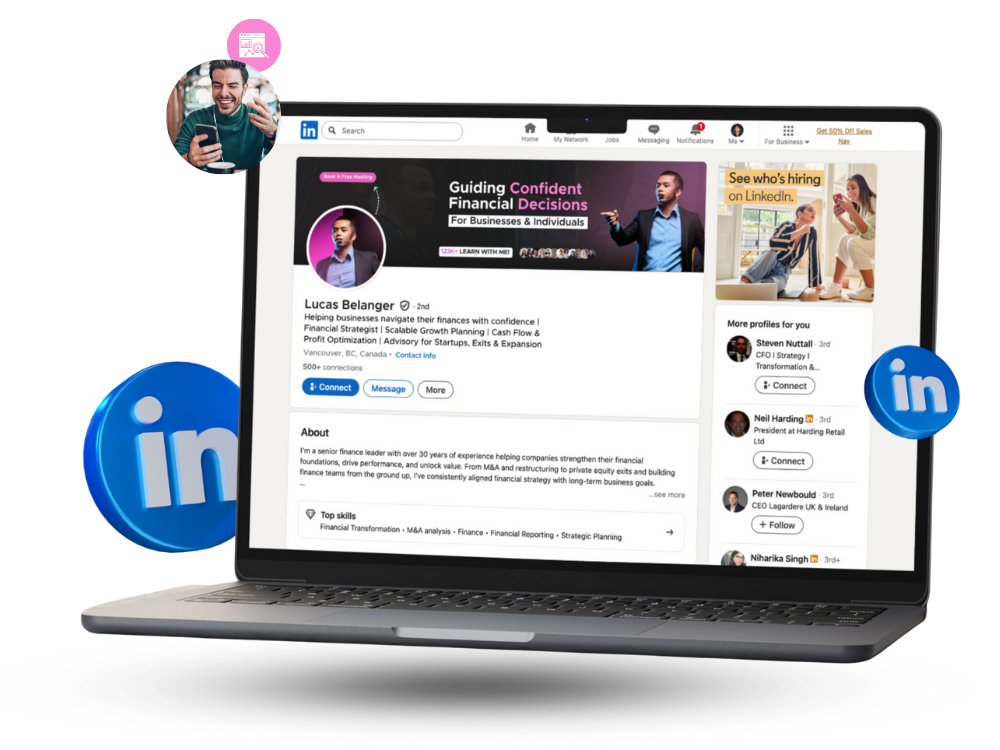
Enhance your LinkedIn presence and attract more opportunities with a profile designed to stand out.
PICK YOUR MAKEOVER
Discover 7 practical LinkedIn lead generation strategies for entrepreneurs, small businesses, CEOs, and executives. Learn how to attract qualified leads, build trust, and turn LinkedIn connections into business opportunities.