
September Is Here: How to Get Your LinkedIn Profile Job-Search Ready

How to Get Your LinkedIn Profile Job-Search Ready
September can be a useful reset point for your LinkedIn job search, especially if your profile has been sitting untouched for months. As summer winds down, professionals return to work, organizations begin new projects, and hiring activity can pick up in some industries.
September has traditionally been a busy month for hiring, but that doesn’t mean a flood of new jobs is guaranteed. LinkedIn has referred to this seasonal uptick as the “September Surge,” when hiring often picks up after a quieter summer. But the strength of that surge can vary from year to year depending on what’s happening in the job market and the broader economy.
The timing matters even more in today's competitive job market. LinkedIn's 2026 research found that 65% of people globally say finding a job has become more challenging, with competition identified as the main hurdle, while 59% of recruiters say AI is already helping them discover candidates they might otherwise have missed.
That means preparing your LinkedIn profile for a job search is no longer just about making it look professional. Your profile needs to make your target role, skills, experience, and career direction clear enough for both people and technology-assisted hiring processes to understand.
In this guide, we'll walk through how to update your LinkedIn profile for job searching, improve your search visibility, connect with recruiters more strategically, and turn LinkedIn into more than a place to submit applications.
Is September Really a Good Time to Look for a Job?

Is September Really a Good Time to Look for a Job?
September can be a productive month for job seekers because it often marks a return to normal business activity after the summer. Factors such as returning decision-makers, renewed projects, budget activity, and increased recruitment as reasons September can bring fresh opportunities.
Its important not to treat the September hiring surge as a guarantee. LinkedIn's own coverage has noted that hiring patterns can vary depending on economic conditions, and feedback from recruiters cautions against assuming that every September will produce a dramatic increase in opportunities.
The better takeaway is simple: Use September as motivation to get ready, not as your starting point. If your LinkedIn profile, résumé, portfolio, networking strategy, and job alerts are already prepared, you can respond quickly when a relevant or interesting role appears, instead of spending the first few weeks of the hiring cycle rebuilding your professional presence.
And there is another reason to get ahead. LinkedIn's 2026 research shows that job seekers are facing stronger competition while recruiters are increasingly using AI in candidate discovery and screening. This means being qualified is only part of the equation…you also need to make your qualifications easy to find and understand.
First, Make Sure Your LinkedIn Profile Matches the Jobs You Want

Make Sure Your LinkedIn Profile Matches the Jobs You Want
Before applying to dozens of positions, look at your LinkedIn profile through the eyes of the recruiter you want to attract. If someone searches for your target role and lands on your profile, would they immediately understand what you do, what you specialize in, and what kind of opportunity you're looking for?
Start with your headline, About section, experience, education, and skills. These sections should tell a consistent story about your career direction rather than presenting a collection of unrelated keywords and previous responsibilities.
LinkedIn's own job recommendations use information from your profile, including your headline, About section, experience, education, and location preferences, to personalize the jobs shown to you. Keeping these sections current helps LinkedIn better understand the types of roles that may be relevant to you.
If you're actively looking, consider using LinkedIn's Open to Work feature as well. You can specify the types of roles and locations you're interested in. LinkedIn says this information can help your profile appear in relevant recruiter searches and you can choose to share your status with all LinkedIn members or privately with recruiters.
Don't simply switch on Open to Work and stop there, though. The feature works best when the rest of your profile supports your career direction and professional development strategy.
Use Keywords Recruiters Are Actually Searching For

Use Keywords Recruiters Are Actually Searching For
LinkedIn SEO for job seekers starts with understanding the language used in the roles you want. Recruiters can search candidates using job titles, skills, locations, industries, companies, and other criteria, so the terminology appearing on your profile can influence whether your experience is relevant to a particular search. LinkedIn Recruiter, for example, includes filters for job titles, skills, companies, industries, schools, languages, and other candidate attributes.
This doesn't mean filling your profile with every keyword you can find. Instead, identify the terminology that consistently appears in the roles you're genuinely targeting and incorporate it naturally into your profile.
How to Find the Right Keywords
Start by reviewing five to ten job postings for the type of position you want. Look for terminology that appears repeatedly across employers rather than relying on the language from a single posting.
Pay particular attention to:
Exact job titles
Technical skills
Software and platforms
Certifications
Industry terminology
Methods or frameworks
Functional responsibilities
For example, if you're targeting digital marketing roles, don't rely only on a term like "marketing professional." Job postings may repeatedly mention terms such as SEO, content marketing, Google Analytics, paid media, social media strategy, email marketing, or campaign management. If those skills genuinely reflect your experience, they are much more useful signals than a broad label alone.
Where to Put Keywords on Your Profile
Your headline is one of the strongest places to establish your professional direction because it appears prominently across LinkedIn. Combine your target role with one or two relevant specializations rather than trying to list everything you can do.
Your About section gives you more room to incorporate related terms naturally while explaining your experience and career goals. Your Experience section should then demonstrate those keywords through actual responsibilities, projects, tools, and outcomes.
Finally, review your Skills section and prioritize the capabilities most relevant to your target roles. The objective is consistency: if your headline says you're a project manager but your About section and Experience section never mention project management, your positioning becomes unclear.
Most importantly, don't add skills you don't have simply because they appear frequently in job postings. LinkedIn SEO should improve discoverability without compromising accuracy.
Turn Your LinkedIn Profile Into More Than an Online Résumé

Turn Your LinkedIn Profile Into More Than an Online Résumé
A job-ready LinkedIn profile should not simply repeat your résumé word for word. Your résumé is designed primarily for applications; your LinkedIn profile can provide additional context, demonstrate your professional interests, and give recruiters and hiring managers a better sense of how you think and communicate.
This is especially useful when competition is high. LinkedIn's research shows that job seekers are increasingly concerned about standing out in an AI-driven hiring environment, while recruiters are using AI to uncover candidates with relevant skills. Your profile needs both searchable information and enough substance for a human to see the person behind the keywords.
Showcase Your Work
Use your Featured section to bring your strongest evidence closer to the top of your profile. Depending on your profession, that could include a portfolio, presentation, article, case study, research project, website, video, publication, or another piece of work that demonstrates what you can do.
Your Experience section can also become more useful when you add relevant media. Rather than saying you "managed social media," for example, you could include a campaign you worked on or a project that demonstrates the outcome of that work.
Recommendations can provide another layer of credibility. A former manager, client, colleague, professor, or project partner can describe qualities that aren't always obvious from a résumé, such as your communication, reliability, leadership, problem-solving, or ability to work with others.
If you're not sure where to begin with profile optimization, designACE's LinkedIn Playbook Series 1: Profile Power-Up provides practical guidance on improving your headline, banner, profile photo, and About section.
Engage and Share
You don't have to become a daily LinkedIn creator to benefit from being active on the platform. Start by following companies and professionals in your target industry and engaging thoughtfully with content that is relevant to your career interests.
You can also share an insight from a project, discuss something you've learned, comment on an industry development, or explain your perspective on a topic related to your target field. The purpose isn't to pretend you're an established thought leader, it's to give people additional evidence that you're engaged with the industry you want to join.
This can be particularly useful when combined with your job search. Someone who sees your thoughtful comment on an industry post may click through to your profile, and if your profile clearly communicates your skills and career direction, that interaction can become another path to an opportunity.
How to Use LinkedIn to Find and Connect With Recruiters

How to Use LinkedIn to Find and Connect With Recruiters
Updating your profile is only one part of a successful LinkedIn job search. LinkedIn also gives you tools to find relevant jobs, create alerts, research companies, identify hiring professionals, and build relationships before or alongside submitting applications.
LinkedIn's current job-search guidance recommends using detailed searches and setting up job alerts based on your preferences and previous searches. You can create alerts for relevant searches and choose whether to receive them daily or weekly.
Finding the Right Recruiters
Don't connect with every recruiter you can find. Instead, identify people who actually recruit for the roles, industries, locations, or companies you're targeting.
You can search for terms such as "Technical Recruiter," "Talent Acquisition," "Talent Partner," or a more specific recruiting title alongside your target industry. You can also visit the LinkedIn Page of a company you're interested in and explore its people to identify members working in recruitment or talent acquisition.
Another useful approach is to look at the people associated with current job postings. If a recruiter, hiring manager, or talent professional is visibly connected to the hiring process, understanding their role before reaching out can make your networking much more relevant.
You don’t aim to collect recruiters, but to build a smaller network of people who are actually connected to the opportunities you're pursuing.
Connecting Effectively
When you send a connection request, give the recipient a reason to understand why you're reaching out. Mention the role, field, shared interest, or specific reason you found their profile relevant rather than sending a generic "I'd love to connect" message.
Keep the first message short. You don't need to include your entire career history, résumé, or a lengthy explanation of why you deserve a job.
For example:
Hi [Name], I'm exploring marketing roles in the [insert industry] and came across your work in talent acquisition at [Company]. I'd be glad to connect and learn more about opportunities in the field.
That creates an opening for a conversation without immediately asking someone to find you a job.
If you're interested in going deeper into this approach, designACE's Outreach That Feels Human Playbook focuses specifically on personalized connection requests, follow-ups, and relationship-building.
Stop Applying to Jobs and Waiting; Build Relationships Too

Stop Applying to Jobs and Waiting; Build Relationships Too
A strong LinkedIn job search isn't only about finding a vacancy, submitting an application, and refreshing your inbox. Some of the most valuable opportunities can begin before a position is publicly advertised, which is why building relationships with people in your target industry can complement your applications.
That doesn't mean asking strangers for jobs. Instead, use LinkedIn to learn about companies, understand your industry, reconnect with former colleagues, and have genuine conversations with professionals whose work interests you.
You have to engage naturally. A thoughtful comment on someone's post can create familiarity before you ever send a connection request, and a short message after connecting can open the door to an informational conversation.
This approach aligns with what LinkedIn has emphasized in its own fall-hiring tips: job seekers can benefit from having a targeted list of companies and contacts, improving their personal brand, and engaging with people at organizations they want to work for rather than relying entirely on applications.
The Outreach That Feels Human guide from designACE goes deeper into this relationship-first approach, including how to personalize outreach, engage before messaging, and move conversations toward meaningful professional connections.
Make Your LinkedIn Job Search More Consistent

Make Your LinkedIn Job Search More Consistent
One of the easiest ways to lose momentum is to treat your job search as something you do only when you're motivated. A simple weekly routine can make the process more manageable and help you stay visible while you're applying. You can also review your profile periodically to make sure new certifications, projects, achievements, or career interests are up to date.
Creating LinkedIn job alerts can remove some of the manual work. LinkedIn currently allows members to create up to 20 job alerts and choose daily or weekly notifications, making it easier to monitor specific roles or companies without repeatedly performing the same searches.
Your routine might be as simple as:
Monday: Review new job alerts and shortlist relevant roles.
Tuesday: Engage with two or three industry posts.
Wednesday: Research a target company and identify relevant contacts.
Thursday: Send one or two personalized connection requests.
Friday: Review applications, conversations, and profile activity.
The exact schedule isn't important. What matters is creating a repeatable process that keeps your job search moving even when individual applications don't work out.
Quick Tips for Getting Your LinkedIn Profile Job-Search Ready
If you're preparing for a September job search, focus on these priorities first:
Update your headline with the roles and skills you're targeting.
Rewrite your About section so your career direction and strongest qualifications are immediately clear.
Review your keywords against several current job descriptions.
Update your Experience and Skills sections with relevant tools, achievements, and capabilities.
Add projects, portfolio pieces, or other evidence to your Featured and Experience sections.
Turn on ‘Open to Work’ if appropriate for your situation and choose the visibility option you're comfortable with.
Set up targeted job alerts instead of relying entirely on manual searches.
Build relationships alongside applications by engaging with professionals and companies in your target field.
Review your profile regularly rather than waiting for another major career transition.
If you want a more structured approach to LinkedIn content and visibility, designACE also offers free resources covering profile optimization, content, outreach, and metrics through its four-part LinkedIn Playbook Series.
When Your LinkedIn Profile Needs More Than a Quick Update

When Your LinkedIn Profile Needs More Than a Quick Update
Sometimes the issue isn't that your LinkedIn profile is incomplete. It's that you aren't sure how to position your experience for the opportunity you want next.
This can happen during a career transition, after a promotion, when changing industries, or when your current profile simply doesn't communicate the level of work you're capable of doing. A profile can be technically complete and still fail to make your value obvious.
A LinkedIn Audit can be a useful starting point because it gives you an outside perspective on positioning, search visibility, messaging, and areas that may be weakening your first impression. designACE offers a free LinkedIn Profile Audit designed to provide actionable recommendations before you decide whether additional support is necessary.
If you'd rather have the profile work done for you, LinkedInMakeover.ca, powered by designACE, focuses on strategic profile messaging, positioning, SEO, and visual optimization. designACE's current services also include LinkedIn Makeover specifically for professionals looking to strengthen their presence and create more opportunities.
Final Thoughts: Don't Wait for the Perfect Job to Fix Your LinkedIn Profile
September can be a useful moment to reset your LinkedIn job search, but the strongest advantage comes from being prepared before the opportunity appears. In a competitive market where recruiters are increasingly using AI and job seekers are finding it harder to stand out, a complete, targeted, and credible profile can help make your professional value easier to discover.
Treat your LinkedIn profile as an active part of your career strategy rather than a digital résumé you update once a year. Keep your positioning current, build relationships alongside applications, monitor relevant opportunities, and keep refining your profile as your career develops. If you want an outside perspective, start with a free LinkedIn Audit or explore a LinkedIn Makeover to get your profile strategically job-search ready.
Frequently Asked Questions (FAQs)
-
September can be an active period for hiring because organizations and professionals return from the summer and begin new projects and planning cycles. However, there is no guaranteed September hiring boom, and conditions vary by industry, location, and economic climate.
-
If you're actively looking for a job, Open to Work can help communicate your career interests to recruiters. LinkedIn allows you to choose whether your status is visible to all members or only to recruiters, although LinkedIn notes that recruiter-only visibility cannot be guaranteed to remain completely private from your current employer.
-
There is no need to create alerts for every possible variation of a job title. Start with a small number of highly relevant searches covering your target roles, locations, and perhaps specific companies, then adjust them as you learn more about the market. LinkedIn currently allows up to 20 job alerts per member.
-
Either can work depending on the situation. If a relevant position is already open, don't delay an application simply because you haven't connected with the recruiter; you can apply and then build a relevant connection separately. The important thing is that your outreach is thoughtful and relevant rather than using networking as a substitute for applying.
-
Yes. Professional LinkedIn optimization can be useful if you know what roles you want but are struggling to communicate your experience, positioning, and strengths clearly. designACE's LinkedIn Makeover is designed to strengthen profile messaging, positioning, SEO, and visual presentation, while its free LinkedIn Audit provides an actionable starting point for identifying areas to improve.
Useful Blogs

LEVEL UP YOUR LINKEDIN PROFILE
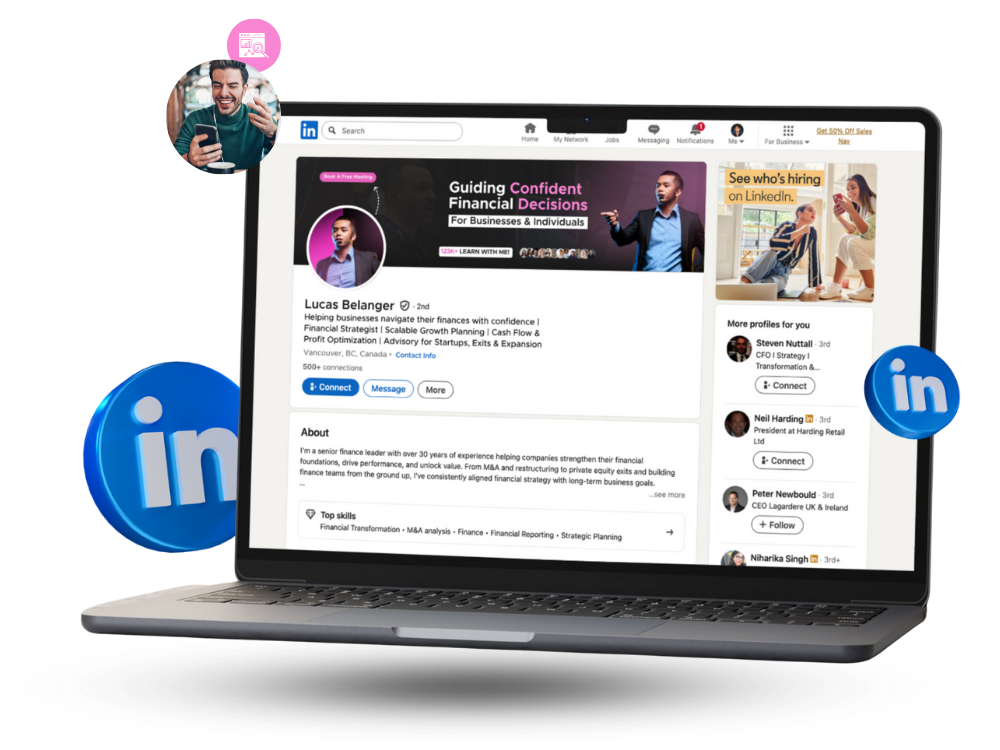
Enhance your LinkedIn presence and attract more opportunities with a profile designed to stand out.
PICK YOUR MAKEOVER
Learn how to build a standout LinkedIn profile as a new graduate by showcasing your skills, projects, education, and potential.